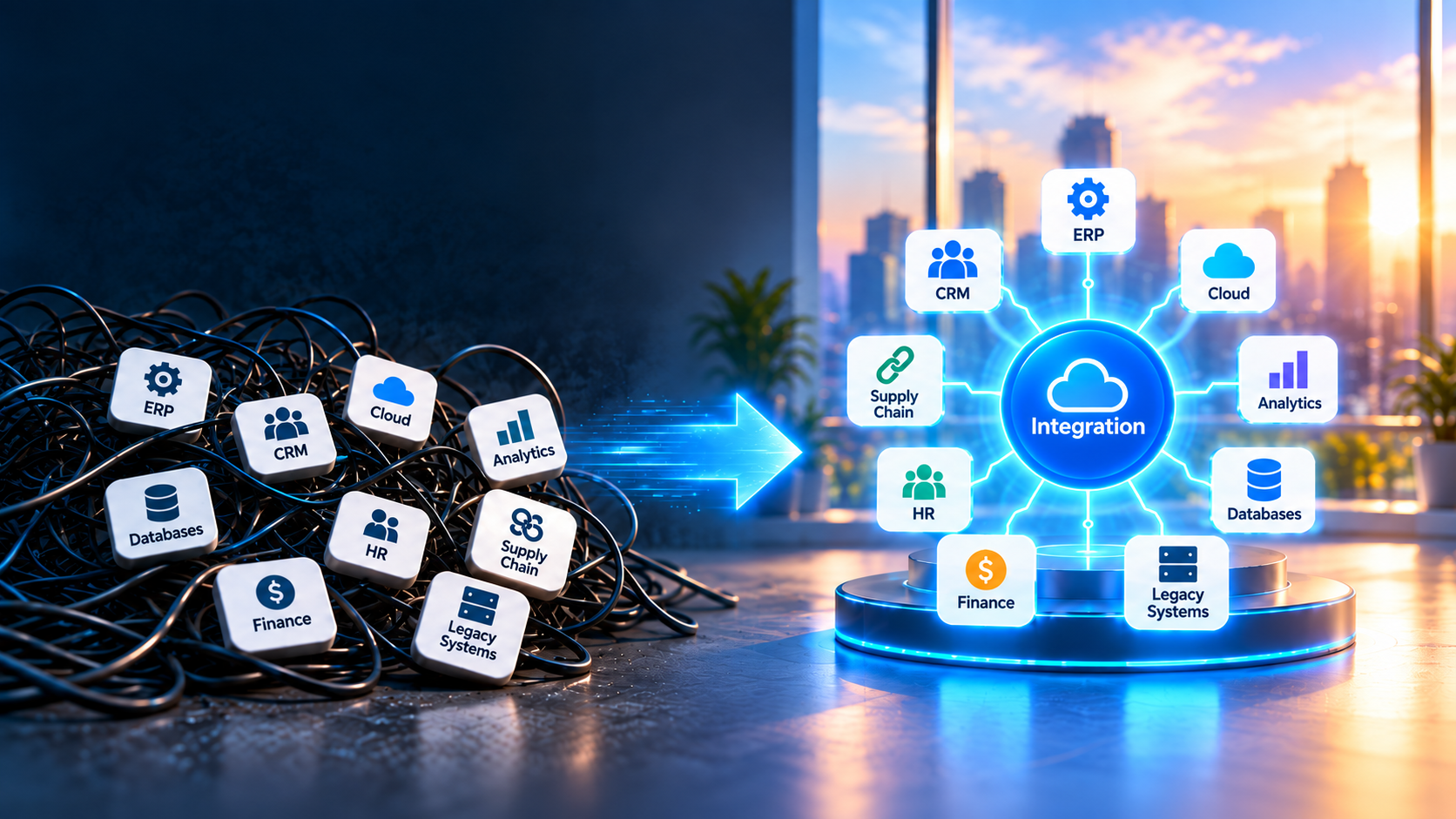
Disconnected systems don't just create technical debt they create operational and strategic debt. Your systems may not be working together.
When enterprise applications, data, cloud platforms, and business processes operate in silos, organizations can end up spending more on technology while getting less business value from it.
The result is slower decision-making, operational inefficiency, limited visibility, missed revenue opportunities, and a business that becomes harder to scale. This is where enterprise integration becomes a strategic priority.
The Real Cost of Disconnected Systems
For many organizations, the challenge isn't a lack of technology. It is a lack of connectivity between the technology they already have. A typical enterprise may rely on:
ERP systems
CRM platforms
HR applications
Financial systems
Supply chain platforms
Customer portals
Databases
Data warehouses
Analytics platforms
AI applications
Legacy systems
When these systems cannot communicate effectively, employees often become the integration layer. Teams manually move information between applications. Data gets duplicated. Reports require reconciliation. Customer information becomes inconsistent.
What begins as a technical limitation eventually becomes a business limitation.
Why Integration Is a CEO Issue, Not Just an IT Issue
Enterprise integration is often treated as an infrastructure or application problem. But the impact reaches the boardroom.
A disconnected technology environment can affect:
Revenue
When customer, sales, product, and operational data are fragmented, sales teams may have limited visibility into customer activity and opportunities.
This can make it harder to identify cross-sell opportunities, personalize customer interactions, and respond quickly to market demand.
Operational Efficiency
Manual data entry, repetitive processes, and reconciliation between systems consume employee time.
Integration can automate the movement of information between systems and reduce unnecessary operational work.
Customer Experience
Customers expect organizations to provide connected experiences.
If information is fragmented between CRM, ERP, customer service, ecommerce, and other platforms, customers may experience delays, inconsistent information, or repetitive interactions.
Decision-Making
Executives need accurate and timely information.
When data is spread across disconnected systems, leadership may spend more time validating information instead of acting on it.
Business Agility
Every new application, acquisition, market expansion, or transformation initiative can become more complicated when the underlying technology environment is heavily siloed.
A connected architecture gives organizations greater flexibility to adapt
The Integration Gap Can Become a Growth Gap
Consider a company that has invested in a modern CRM, ERP, cloud infrastructure, and analytics platform. On paper, the technology stack looks sophisticated. But if the CRM doesn't effectively communicate with the ERP, customer and order information may remain disconnected.
If the ERP isn't connected to the analytics environment, leadership may not have timely visibility into business performance. If cloud applications aren't integrated with legacy systems, employees may continue using manual processes. If APIs are poorly managed, adding new digital services can become slower and more expensive.
The organization has invested in digital transformation, but the connections between the investments are missing. That is the integration gap.
Five Business Problems Caused by Poor Integration
1. Manual Workflows Increase Operating Costs
Employees often compensate for disconnected systems through spreadsheets, emails, manual data entry, and repetitive reconciliation. These processes may appear manageable when the business is small. At enterprise scale, they become expensive and difficult to control.
The business question for leadership is not simply "Can we automate this?"
It is:
"How much of our workforce is spending time moving information between systems instead of creating business value?"
2. Fragmented Data Limits Business Intelligence
Data is one of an organization's most valuable assets—but only when it can be accessed and understood. Data integration helps organizations connect information across systems so that analytics and reporting can provide a more complete view of the business.
For CEOs, this means moving from fragmented reporting toward more connected, timely business intelligence.
3. Customer Experiences Become Disconnected
Customers don't think in terms of your internal systems. They expect a seamless experience. Whether they interact with sales, customer service, ecommerce, billing, or support, they expect the organization to understand their relationship with the business.
Application integration can connect the systems behind these interactions and help create a more consistent customer journey. Better integration can therefore become part of the customer experience strategy—not simply the IT strategy.
4. Innovation Becomes Slower
Every new technology initiative depends on the existing technology environment.
Want to introduce AI? - You need access to relevant data.
Want to launch a new digital service? - You need application and API connectivity.
Want to move to the cloud? - You need to consider integration with existing applications and data.
Want to automate a business process? - The underlying systems need to exchange information.
Without an integration strategy, every new initiative can require another custom connection. This creates complexity and slows innovation.
5. Technology Costs Can Increase
Maintaining multiple disconnected systems can create hidden costs. Over time, the technology environment can become increasingly difficult to manage. The issue isn't necessarily how many systems an organization has.
It is how effectively those systems work together.
API Integration Is Becoming a Critical Business Capability
APIs allow different applications and services to communicate with each other.
For modern enterprises, API integration can help connect internal applications, cloud services, partner platforms, mobile applications, customer-facing systems, and third-party services.
A strong API strategy can help organizations:
Connect applications
Reuse business capabilities
Accelerate digital product development
Improve system interoperability
Support automation
Connect cloud and legacy environments
Enable partner ecosystems
For businesses expanding their digital offerings, APIs can become an important component of the technology foundation.
Cloud Integration Is Critical to Digital Transformation
Cloud adoption does not eliminate integration challenges.
In many cases, it creates new ones.
This makes cloud integration an increasingly important component of enterprise architecture.
The goal is to ensure that cloud environments don't become another set of isolated technology silos.
Instead, cloud platforms should connect with the applications, data, and processes already supporting the business.
Oracle Integration and Enterprise Applications
For organizations operating Oracle environments, integration can be particularly important.
Enterprise applications such as Oracle Cloud, Oracle Fusion Applications, ERP, HCM, supply chain, finance, and customer applications often need to exchange information with other enterprise systems.
Oracle integration can help organizations connect Oracle applications with:
CRM platforms
SAP environments
Microsoft applications
Cloud platforms
Databases
Legacy systems
Third-party applications
APIs
Data and analytics platforms
The objective is to create a connected enterprise environment rather than treating ERP or enterprise applications as isolated systems.
From Point-to-Point Integration to an Enterprise Integration Strategy
One of the challenges organizations face is accumulating integrations over time.
One application connects to another.
Then another connection is added.
Then another.
Eventually, the organization may have a complex network of point-to-point integrations that becomes difficult to understand and maintain.
How DWT Technology Can Help
DWT Technology helps organizations design and implement integration strategies that connect applications, data, APIs, cloud environments, and enterprise platforms.
From integration strategy and architecture through implementation and ongoing support, DWT Technology helps businesses build a more connected technology environment.
Is Your Integration Strategy Ready for the Next Stage of Growth?
DWT Technology can help assess your technology ecosystem, identify integration opportunities, and develop a roadmap aligned with your business objectives.
Talk to Our Integration Experts