The UAE's position among the world's most affected countries for cyber threats is a reminder that cybersecurity must be treated as a business priority. For company’s, the challenge is not just preventing attacks; it's protecting business continuity, customer trust, critical data, and long-term growth.
The United Arab Emirates has established itself as a regional hub for financial services, government, logistics, healthcare, technology, and digital innovation. As organizations accelerate cloud adoption, enterprise automation, and artificial intelligence (AI), their dependence on connected digital systems continues to grow.
That progress also creates a broader environment for cyber risk.
According to Microsoft's 2026 Digital Defense Report, the UAE ranked sixth globally among countries where Microsoft customers were most frequently impacted by cyber activity during the first half of 2026. The United States, Israel, Ukraine, Taiwan, and the United Kingdom ranked ahead of the UAE in the reported list.
The findings highlight a critical issue for enterprise leadership: cybersecurity risk is becoming increasingly interconnected, with compromised identities, vulnerable systems, and third-party dependencies potentially affecting more than one organization.
For CEOs, this is not simply an IT security concern. It is a question of operational resilience, financial exposure, governance, and the ability to pursue digital transformation without introducing unmanaged risk.
Why the UAE's Cyber Threat Ranking Matters to Business Leaders
A country's position in a threat report does not mean every business operating there faces the same level of risk. Microsoft's findings reflect its observed customer telemetry and should be interpreted within that context.
However, the ranking reinforces the importance of understanding the security risks facing digitally connected organizations.
Businesses in the UAE increasingly depend on enterprise resource planning (ERP), customer relationship management (CRM), cloud infrastructure, APIs, data platforms, and AI-enabled applications. These technologies create opportunities for growth, but they also introduce additional access points and dependencies that need to be secured.
A weakness in one part of the technology environment can have consequences elsewhere.
For example, a compromised employee account could expose business applications. An unsecured integration could allow unauthorized access to sensitive information. A vulnerable third-party platform could disrupt a critical business process.
It is whether the business can prevent, detect, contain, and recover from an incident without unacceptable disruption.
1. Cybersecurity Is Now a Business Continuity Issue
Many organizations still evaluate cybersecurity primarily through the lens of technology controls, including firewalls, endpoint protection, antivirus software, and monitoring tools.
These controls matter, but they do not guarantee that a business can continue operating during a cyber incident.
A successful attack could affect customer-facing services, financial operations, internal applications, supply chains, or access to critical business data.
The financial impact can extend beyond the immediate cost of remediation. Organizations may also face operational downtime, contractual consequences, regulatory scrutiny, customer concerns, and reputational damage.
CEOs should therefore connect cybersecurity planning directly with business continuity.
That means identifying the systems that are essential to operations, understanding their dependencies, and determining how the organization would respond if those systems became unavailable or compromised.
2. Identity and Access Are Critical Security Priorities
One of the most important findings in Microsoft's 2026 reporting is the continuing significance of identity-based attacks.
Attackers often seek access through compromised credentials, phishing, weak authentication, or accounts with excessive privileges. Once inside, they may attempt to access additional systems or obtain sensitive information.
This makes identity security a business-wide responsibility.
Consider an enterprise where employees use cloud applications, finance platforms, CRM systems, HR software, and internal data environments. If access permissions are not properly managed, a compromised account could expose far more information than its owner genuinely needs.
The same concern applies to contractors, implementation partners, service accounts, administrators, and automated applications.
3. AI Is Changing Both Cyber Attacks and Cyber Defence
AI is creating new opportunities for businesses to improve productivity, automate decisions, and develop more responsive customer experiences.
However, the same technology can help attackers scale their activities.
AI-assisted techniques can support more convincing phishing messages, impersonation attempts, reconnaissance, and automated attack workflows. At the same time, organizations are increasingly using AI-powered security tools to identify suspicious activity and accelerate investigations.
This creates a dual challenge for enterprise leaders.
Businesses must strengthen their security capabilities while ensuring that their own AI adoption does not introduce additional exposure.
4. Enterprise Integrations Can Create Hidden Exposure
Modern businesses rarely rely on a single technology platform.
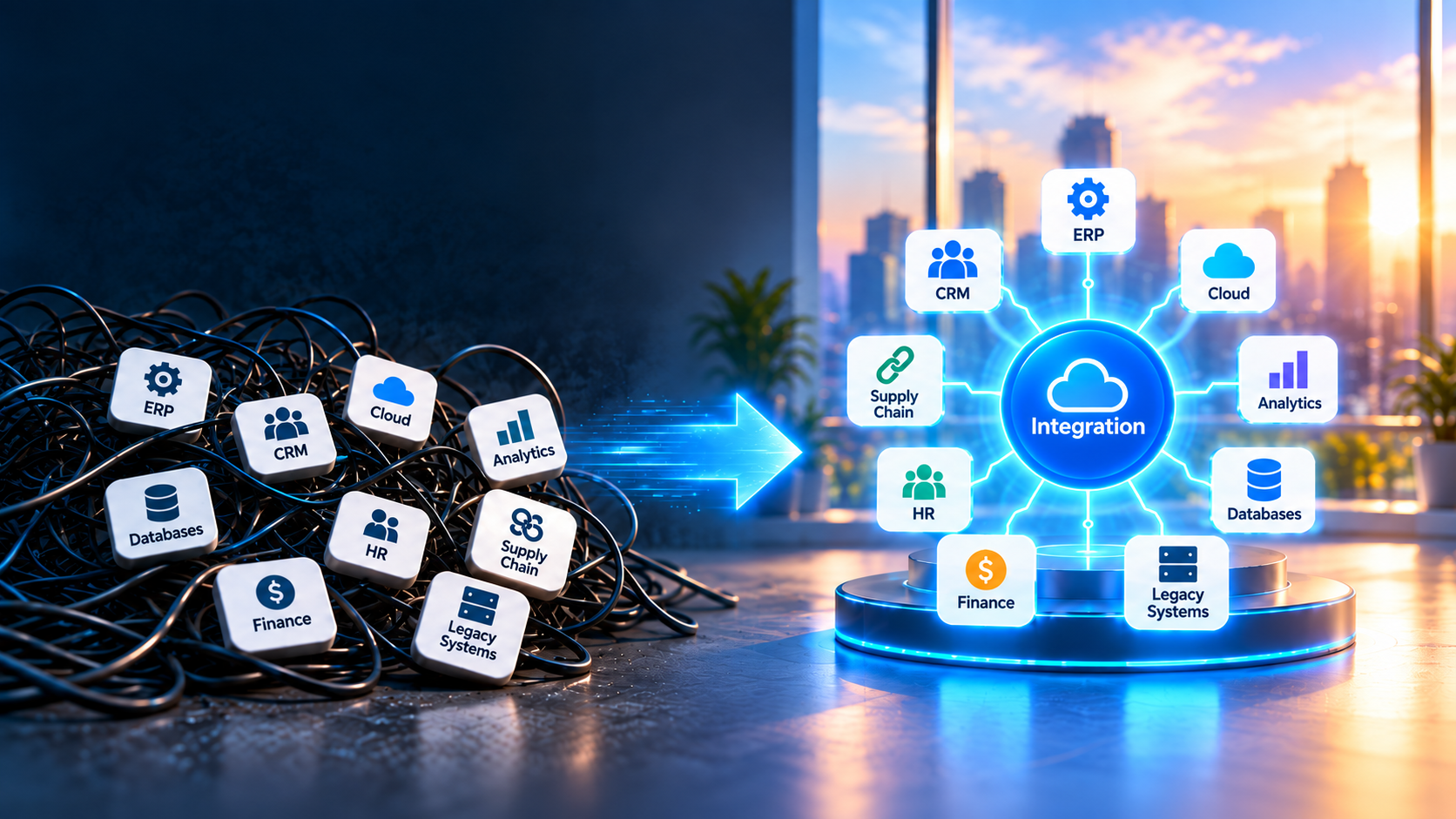
An enterprise may connect its ERP, CRM, HR systems, cloud infrastructure, analytics platforms, payment services, and external partners through APIs and integrations.
Although each system may have its own security controls, weaknesses can emerge where systems connect.
An exposed API, poorly managed service account, excessive integration permissions, or inadequately monitored data flow can create opportunities for unauthorized access.
These risks become more difficult to manage as businesses expand their digital ecosystems.
A security architecture review can help leadership understand how applications communicate, where sensitive information moves, and whether security controls remain consistent across the environment.
5. Cybersecurity Investment Should Be Based on Business Risk
When cyber threats increase, organizations may respond by purchasing additional security products or expanding their existing technology stack.
But more tools do not automatically produce better protection.
Businesses can have substantial security investments and still lack visibility into critical assets, struggle with fragmented monitoring, or leave important vulnerabilities unresolved.
The CEO's responsibility is not to select every security product. It is to ensure that security spending addresses the risks that matter most to the business.
A risk-based approach helps organizations prioritize improvements according to potential business impact, likelihood, existing controls, and the resources required to address each issue.
Build a Cyber Resilience Roadmap Before an Incident Occurs
Cybersecurity maturity is not achieved through a single assessment or technology deployment. It requires ongoing visibility, governance, remediation, and testing.
For executive leadership, the most useful starting point is a structured review of the organization's current security posture.
A practical roadmap can be organized into three stages.
Stage 1: Identify the highest-priority risks
Map critical systems, identities, data flows, cloud environments, and third-party connections. Assess significant vulnerabilities, access weaknesses, and gaps in monitoring or recovery capabilities.
Stage 2: Address the most consequential gaps
Prioritize remediation based on business exposure. Strengthen identity controls, improve visibility, secure critical integrations, review cloud configurations, and address vulnerabilities that pose material risk.
Stage 3: Test resilience and improve continuously
Conduct incident-response exercises, test backup and recovery processes, review access permissions, and reassess security as the business adopts new technologies or changes its operating model.
This approach helps organizations move from reactive security activities toward a more deliberate, risk-based model.
What you Should Do Next
The UAE's position in Microsoft's 2026 cyber threat reporting reinforces a broader business lesson: digital growth and cybersecurity must advance together.
The next step is not necessarily to invest in another security product. It is to understand where the organization is most exposed, which business processes would be affected by an incident, and whether existing controls are sufficient.
Leadership teams should ask five questions:
Visibility: Do we understand our critical assets, identities, integrations, and external dependencies?
Exposure: Which security weaknesses could cause the greatest business disruption?
Investment: Are we directing resources toward the risks with the greatest potential impact?
Resilience: Can we maintain or restore critical operations following a significant cyber incident?
Accountability: Are security responsibilities clearly defined across executive leadership, IT, business units, and third parties?
How DWT Technology Can Help
DWT Technology helps enterprises assess and improve the technology foundations that support secure digital operations.
As organizations expand their cloud environments, enterprise applications, integrations, analytics platforms, and AI capabilities, understanding the security implications of these connections becomes increasingly important.
A structured enterprise technology and security assessment can help organizations identify architectural weaknesses, evaluate critical dependencies, and prioritize improvements according to business risk.
This can include reviewing identity and access controls, cloud environments, application integrations, data flows, third-party connections, and the resilience of critical systems.
The goal is to help leadership make informed decisions about where security improvements are needed and how those improvements can support business continuity and digital transformation.
Discuss Your Enterprise Security Priorities
Frequently Asked Questions
1. Why is the UAE considered a major target for cyber threats?
According to Microsoft's 2026 Digital Defense Report, the UAE ranked sixth globally among countries where Microsoft customers were most frequently impacted by cyber activity during the first half of 2026. The finding highlights the importance of strengthening identity security, protecting critical systems, and preparing organizations to respond to cyber incidents. It reflects Microsoft's observed data and should not be interpreted as a uniform risk level for every UAE business.
2. What are the biggest cybersecurity risks for enterprises in the UAE?
Key risks include compromised identities, phishing, exposed internet-facing systems, unpatched vulnerabilities, insecure integrations, cloud misconfigurations, data exposure, and third-party security weaknesses. The most relevant risks depend on each organization's industry, technology architecture, data sensitivity, and existing security controls.
3. How can a cyberattack affect a company's financial performance?
A cyber incident can interrupt operations, delay transactions, affect customer services, increase recovery costs, and damage customer confidence. Depending on the incident and applicable obligations, an organization may also face contractual, legal, regulatory, or reputational consequences. The financial impact depends on the nature and duration of the disruption and the organization's ability to contain and recover from it.
4. What should CEOs prioritize to improve enterprise cybersecurity?
CEOs should prioritize visibility into critical assets, strong identity and access controls, timely vulnerability remediation, secure cloud and application architecture, third-party risk management, and tested incident-response and recovery plans. Security investments should be aligned with the potential business impact of different risks.
5. How does AI affect enterprise cybersecurity?
AI can help security teams analyze activity, identify patterns, and accelerate investigations. It can also help attackers create convincing social-engineering messages and scale certain malicious activities. Organizations adopting AI should establish appropriate data controls, manage AI permissions, secure integrations, and monitor AI-enabled systems.
6. How often should a business review its cybersecurity posture?
Cybersecurity should be monitored continuously, with formal assessments conducted at intervals appropriate to the organization's risk profile. Reviews are particularly important after major technology changes, cloud migrations, acquisitions, new integrations, AI deployments, significant incidents, or changes in regulatory obligations.
7. What is the difference between a vulnerability assessment and a security architecture review?
A vulnerability assessment primarily identifies known weaknesses in systems, applications, or infrastructure. A security architecture review takes a broader view of how systems, identities, data, integrations, and security controls work together. The two approaches complement each other: vulnerability assessments identify specific weaknesses, while architecture reviews help uncover systemic gaps and understand their wider business implications.